Thursday, July 26, 2007

Sony GV-HD700E HD Video WALKMAN


Sony has finally announced a HD Video WALKMAN – a portable solution for viewing both HDV and DV tapes while you’re on the move. I say finally because a portable back-up unit for this market is long overdue bearing in mind the HDV format is already a few years old. The press release sings the praises of the new unit, due out in September 2007. But there is no mention of price, nor if the unit will play back 1080p tapes recorded by Sony's latest HDV camera. So what are the bets on the price? 1500 Euro?

Sony's story continues...

The clear, bright 7-inch widescreen (16:9) LCD offers a resolution of 1,152K (800x480x3[RGB]) dots for monitoring video and still images. An All-scan function ensures that 100% of the recorded frame area is displayed on the LCD monitor for accurate reviewing of shots. Up to six LCD panel setups can be stored and loaded at any time. The on-screen position of displayed timecode can be moved to any of six positions according to user preference. The screen folds down when the GV-HD700E is not in use for maximum portability.

The HD Video WALKMAN is generously equipped with interfaces for recording and playing HDV1080i and Standard Definition DV video from a range of sources. An HDMI output allows HD viewing on any connected HD-ready TV or monitor.

It’s also the first Video WALKMAN supporting x.v.Colour. Based on the new xvYCC standard, x.v.Colour almost doubles the gamut of colours that can be displayed accurately on an xvYCC compliant display. HDV tapes recorded with x.v.Colour can be replayed with x.v.Colour signals available via HDMI and i.LINK outputs. x.v.Colour signals can also be read via the i.LINK input, and x.v.Colour information is passed through to the portable deck’s HDMI output.

A separate HD/SD component output is provided in addition to the HDMI output. An i.LINK port allows direct recording and playback of HDV and DV signals, while analogue video and audio can be recorded and monitored via S Video and RCA input connectors. In addition, still images can be captured from tape (HDV or DV) during playback and stored onto Memory Stick.

For convenient operation, any of fourteen commonly-used functions (including search, index mark and playback zoom) can be assigned to three function buttons. There’s also a Status Check mode that gives a handy on-screen confirmation of key Audio, Output, Assign and LCD settings.

For extra versatility the GV-HD700E can be used with InfoLITHIUM L and M Series batteries. Supplied accessories include an AC Adaptor, wireless remote controller, component cable and AV Multi Cable (without S Video).

Saturday, June 16, 2007

Heading totally in the wrong direction


close but not really
Originally uploaded by Jonathan Marks
I used to be a fan of Archos in the days when their AV340 used to make great quality audio recordings, as well as fairly decent quality recordings. We waited for the same features, only with a better quality recording, screen and wifi. After a lot of teasing, at places like IBC 2006, Archos has finally come out with the 605 wifi. They must be mainly aiming for the French market because they have signed deals with French suppliers of content. Since it is all DRM protected, I cannot imagine purchasing a film for 12 Euro which will only play on this device in "dvd like" quality - well not on the big plasma screen I have it won't. Perfect example of technology driven products which don't understand the power social currency. Shame, but I am writing these guys off the list of innovators.

Tuesday, May 29, 2007

Earth TV Interview


This is the company that provides all kinds of pictures for TV stations from 55 special cameras positioned around the world. They hate being called a webcam company.

Doublecam from Germany

Interesting device for cameramen collecting Voxpops. Seen at MIP-Tv in April 2007. Cost? 19000 pounds sterling. Quality is excellent. Not sure if I'd want to use it in a warzone though.

Monday, May 28, 2007

Farcast Project

The Dutch research organization, TNO, pops up at many trade fairs, marketing what they're up to. Kobus Smit explained to me what they're doing with the Farcast project aimed at radio and newspaper reporters.

Frauenhofer MP3 Surround


The Frauenhofer Institute in Germany is best known as the place where the MP3 compression standard was developed. Now they've finalized a new compression system to put surround sound onto the mobile using DVB-H

Sunday, May 27, 2007

Yahoo & Broadcast & Mobile

What is Yahoo doing in the mobile world? This is what they're telling the mobile operators at the world's largest exhibition and conference called 3GSM in Barcelona. Curiously, Google wasn't there, yet 60,000 others did make the trip to beautiful Barcelona.

Friday, May 25, 2007

SkyQube

Wanna beat roaming charges on the mobile phone when you're sent as a freelance reporter abroad? With a local SIM card, Skypeout account and this box you can. Although launched at 3GSM back in February 2007, I have yet to see this in (online) shops just yet.

Monday, May 21, 2007

Babelgum - Joost's Nightmare?

Thinking of starting you're own TV station? There may be alternatives to Youtube if you have material longer than 10 minutes.

Sunday, May 20, 2007

GSM Association

Dawn Hartley explains what this young organization does in developing countries like Kenya and Namibia and why. This may be mobile, but I believe what they do is definitely of interest to broadcasters too.

Thursday, May 17, 2007

Nursing the Phone


Just reposted this video because I wasn't happy with the quality of the video on Youtube. There was something wrong with the lip-sync. This Swedish company has a brilliant strategy to market their phones - Swedish nurses looking after a new born baby phone. I notice that this video had been downloaded 500 times in a few hours on Youtube.... It shows you what people are searching for. Katherine was at 3GSM...and they are way ahead of the Apple iPhone, in my opinion.

Monday, May 07, 2007

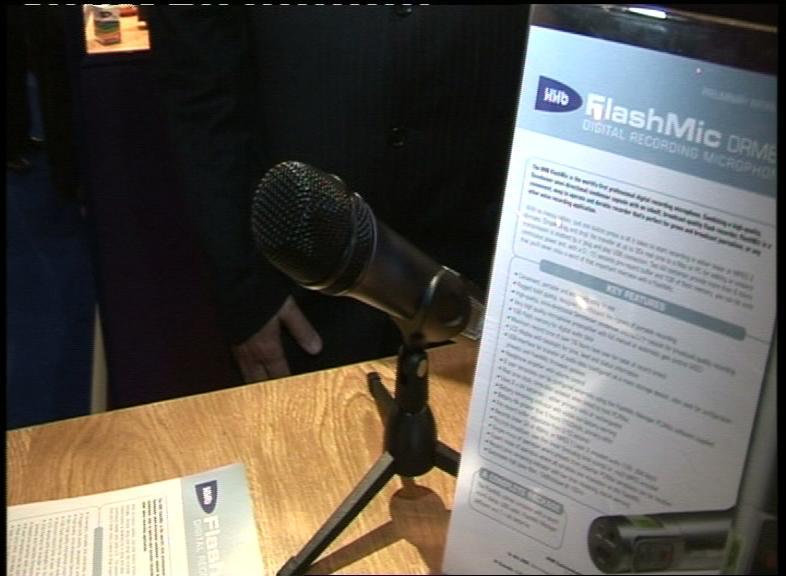
HHB Flash Microphone Recorder - Price reduction

This is an update to a post we put up in September 2005.

Way back on Friday Sep 9th 2005 at IBC Amsterdam, the UK company of HHB launched a great device for radio reporters. Basically, they have built a flash recorder into the base of a Sennheiser microphone, the same looking type which is marketed by Sennheiser as a wireless model. Instead of the transmitter, HHB has put in a flash-recorder into the same housing.

On the bottom are connected for a pair of headphones and a USB jack to the laptop. You can transfer recordings to the laptop at 90 times faster than real time, and there is no quality loss in the transfer since you're copying a digital file. The flash memory unit cannot be taken out (and lost), but you can get plenty of audio in - 3 hours at 48K linear, 18.25 hrs using the MPEG-1 Layer 2 standard at its lowest bitrate. I purchased a unit in 2006 and have found the 3 hour memory capacity to be fine for ordinary reporting. If you were using it to make a documentary, you'll need to dump content to a hard disk on a laptop. HHB say they have no plans to make the memory card removable in this model.

You do the editing of an item on the laptop, not on this device. The beast came out in Jan 2006 at a price of 699 pounds sterling in the UK (VAT extra) and 999 Euros (VAT extra). At the time we complained that the price was on the expensive side.

A press release on May 1st 2007 indicated that the retail price has now dropped to 529 pounds ex VAT in the UK, partly because of volume production and the drop in the cost of internal memory. I asked HHB in London whether this meant they would consider putting 2 GB instead of 1 GB, but the answer was that the feedback from clients indicated that 1 GB was enough for most purposes. Personally, I'd prefer 2 GB so I could use it for longer periods without having to dump to a Hard-disk. But I do more documentary work.

The audio quality of the recordings is great. For very noisy environments, there is also a cardioid version of the same device (the DRM85-C is the same price) which is far more directional. For my purposes, the omni-directional version is fine.

Unlike some other competitors, this Flashmic works on two standard penlight (AA) cells. I use the 2650 mAH capacity rechargeable cells from Duracell and get around 8 hours of recordings without a pause. Always have a couple of batteries spare in case. When the batteries go, they tend to fade rather suddenly.

I plug a pair of closed-type headphones into the base to monitor the sound and spot popping. The casing is rugged and well designed against hand-noise.

Things to bear in mind though;

- There is no audio buffer to allow the unit to be in standby and still capture the start of an important statement. Wouldn't be that practical anyway - you can't remote control this Flashmic since it is built into the base of the microphone.

- No line-in to the recorder. It's a flash microphone.

- Only Mono. No stereo versions

- Flash memory is not removable.


As well as broadcasters, this device might interest some podcasters too who want to interview famous people. There is a social factor here. Somehow the HHB looks better than the M-audio or a mobile phone stuck under someone's nose. They treat you like a professional because the device looks familiar.

Saturday, March 24, 2007

Solar Power Interview with GSMA


Did you know that 60% of the cost of running a mobile phone network in Africa goes in trucking diesel fuel out to base-stations. This interview with Dawn Hartley of the GSMA looks at solar power solutions, which may well be of interest to some reporters in the field.

AEQ PAW 120


469 pounds is a lot to pay for a recorder. Yes it is cheaper than the HHB Sennheiser, but it is also considerably more expensive than the other handheld recorders we've seen. The good news is that the recordings are clean, and you can even get away with using the built-in mike, though politicians may be wary of speaking into something the size of a mobile phone. But the internal memory is either 512 or 1 GB and with MPEG-2 compression (or just WAV) that means very short recording times. That's a pain if you switch the thing on to record a press conference in WAV format and it lasts for more than 40 minutes. Memory full? Have to dump it to a PC before you can continue. Come on guys - haven't we learned anything from the photo camera market? Please lets use removable flash memory - it is cheap enough now.

Overall, I'm disappointed. Decided not to buy..

Reciva 2.0


I was interested to see a demo of the next phase of software to be put in a series of wifi radios being rolled out in the UK and elsewhere. There are other companies working on the same thing, but Reciva have managed to stay ahead by offering a database of some 5000 stations which automatically loads into the receiver.

ShareThis