Saturday, March 25, 2006

Minidisc's Last Gasp?


I predict that MiniDisc is still doomed. But, Sony's HD MiniDisc department seems to be hoping that the new MZ-RH1 will be a success. It is out in a few days in Japan - in May in Europe we're told by Gizmodo. This portable recorder can record using a Linear PCM-format, but also tackle MP3 as well as the proprietary standards that Sony has like atrac, atrac3 and atrac3plus. A new feature is that the device can be connected to an Apple Macintosh, as well as a Windows PC. Cost? Around 300 Euro in Japan. Now why on earth don't they come up with some smaller and lighter based on a hard disc or flash memory format? Problem is that no-one in the Sony Business centre is really interested in audio guys.

Tuesday, March 14, 2006

Hearing Good Things About Onyx


I am hearing good things about a company located near Utrecht in the Netherlands. They call themselves Onyx and they do modifications to Marantz equipment, like the 670. Dutch broadcasters (especially the regional stations and the universities) seem to like them.

Onyx tell me they also used to offer an interesting flash recorder option that fitted into the base of the microphone (an earlier version of the HBB idea) which used a Korean flash recorder in the base. But Onyx tell me that despite what it says on their website, the Repoflash has been discontinued because the supply of mp3 recorders dried up. They are supporting the Marantz 660 as a suitable replacement. The 660 retails at just under 800 Euro (ex 19% VAT) in the Netherlands.


Onyx
advanced audio technologies
Grindmeer 15
3994 JA Houten
The Netherlands
Tel.: +31-30-2599571
Fax.: +31-30-2599572
E-mail: info@onyx-audio.com

Onyx Repopack


The Onyx site also describes a RepoPack (made mainly for the Dutch media market). It consists of a Marantz PMD670 recorder (with a special Onyx limiter modification which has a faster attack time and keeps the peaks below 0dB). They also market an Onyx protective reporter carrying-case, including a useful accessory pocket for microphone, cables, AC/DC adapter etc and a shoulder-length carry-strap.

Despite what it says (in mid March 06) on their website, Onyx used to market their own RB2000 rechargeable Ni-MH battery with a capacity of 2Ah (working time approx. 8 hours!), but since Marantz has dumped the original Ni-Cd batteries and also switched to Ni-MH batteries, they just use the Marantz batteries now.

I'm quoted 895 Euro for the PDM670, 125 Euro for the battery, and 150 Euro for the special case. All prices exclude 19% VAT. Flashcard prices extra. They can supply Compact Flash cards,recommending the Pretec high speed pro Compact Flash cards, available in most regular MB sizes.

Pity their website hasn't been updated since 2004. But they are well-known in the Dutch media business as reliable.

Blast from Bournemouth

Just had this great reaction from Andrew Higginson in the UK which I thought I'd post here in full (with his permission).


I'd probably better say who I am first. I work at Bournemouth University and look after the radio studios in the Media School. I'm also a part time student on the MA Radio Production course lead by Sean Street and Hugh Chignell.

We have over the last 2 years gone for the Marantz PMD 670. We now have over 30 of these. When we bought the first batch, the 660 had not been released, and on getting the second lot, there were a lot of very bad reviews for the 660, so we left these. We were due to be looking to replace our remaining MD machines this year, however as the solid state market is in a point of flux, we are leaving it for another year.

Reading through all of the technical reviews, the main problem with the 660 seems to be distortion on the mic inputs. It seems to be a design issue and not something that can be sorted with a firmware upgrade. There is a very good discussion on these issues on the Transom forum.

The Microtrack has had a lot of bad press due to the phantom power on the mic sockets. In the original spec, it was meant to be 48v. In the production model, this had fallen to 30 volts and some mics don't like this.

I've had a play with one of the HHB pre production Flash mics and I must say I like it. It is simple and easy to use. It has 1gig of memory on board and looks like a normal memory stick drive to any computer it is connected to. It also takes standard AA batteries so it is not too much of a problem on the road. However, there is a cost. The figures I have heard is about £700 a unit! Andrew Hingley at HHB should be able to tell you more.

One thing to look out for is the mics you use with the recorders. Out of all of the dynamic reporter mics on the market, the Audio Technica has the highest output and the Beyer M58 the lowest. There are also some Condenser mics out there as well that have a higher output level. Email me if you want more info, but the main issue is how well the mics drive the input stage of the recorders. The lower the mic output, the more gain you have to use and the more hiss you get.

Looking through the specs of ENG omni mics, there is a fair difference between different mics. There is a lot of mention about the low output levels of dynamic mics. However, some are a lot lower than others. From the specs on the manufacturers sites, the following a listed.

AKG
D230 2.5 mV/Pa (-52 dBV), 320 Ohms

Audio Technica
AT804 -49 dB (3.5 mV), 600 Ohms
ATM10a -45 dB (5.6 mV), 270 Ohms

Beyer
M58 1.3 mV/Pa ≡ -58 dBV, 200 Ohms
MCE58 4 mV/Pa, 370 Ohms

Electrovoice
RE50N/D 2.0mV/Pa (-51dB), 150 Ohms
RE50 -55dB, 150 Ohms
635 -55dB, 150 Ohm
635n/D 2.0mV/Pa (-51dB), 150 Ohms

Sennheiser
MD42 and 46 2.0mV/PA, 350 Ohms
K6 / ME62 31mV/PA, 200 Ohms

Shure
VP63A -51.5dBV/Pa (2.7mV), 300 Ohms
SM63 -56.5dBV/Pa (1.5mV), 150 Ohms

Looking through all of these specs, yes I know that they are not being tested under identical conditions, but it does show a fair difference in output levels. In the past, I have found the Beyer M58 to have a lower output level than the Audio Technica AT804 and where the 804 worked ok, the M58 was too low. Teac portable DATs are one example. The problem I have had with the AT804 is that it is very short. It is only 6 inches long compared to 10 inches for the M58. Audio Technica have now released the AT804L which is about 10 inches in length to allow them to fit into the market with the likes of the M58 and D230.

As mentioned before, Beyer have produced the MCE58 as an answer to the portable MD market. On their website they say "Its unbalanced output supplies a very high level which allows direct connection to mobile DAT and MD-machines." From what people have said, this is a good mic.

If you want a good high level from a mic, the Sennheiser K6 / ME62 has a very high output compared to other Dynamic and Condenser mics.

Personally, I have a Sharp SR50 and a couple of AKG D230 mics. It seems to work ok and I do have manual level control during recording. I've got 2 of the mic cables mentioned in my last post plus a Y splitter for the mics. This is a Stereo Minijack plug to 2 Minijack sockets to allow 2 mics to be connected.

Somebody mentioned about handling noise in an earlier post. I take it you are holding a loop of cable at the mic end. Loop the cable once and hold the loop against the mic with the same hand you are holding the mic with. This will reduce a lot of the handling noise. I let my students hear the mic cable being tapped about 12 inches down from the mic without the look and it picks up a lot of noise. With the loop, there is very little noise.

Monday, February 27, 2006

Work in Progress

 
Been doing so early morning travelling recently and using the opportunity to examine the survey forms that over 500 of you were kind enough to return. It is clear that the freelance radio reporter market is angry with the equipment suppliers. All the current solutions for recording audio seem to have some flaw - from complicated menus to serious overpricing. Bear with me as I tabulate the results. Your input has been worth it.

Jonathan Posted by Picasa

Monday, February 06, 2006

Great Features But Maybe Too Late


How many of you have taken the plunge and invested in HD-Minidisc? Will it go the way of many Sony lines at the moment? Can you afford to take the risk? If you have, then Tim Locke advises you download SonicStage 3.4 (Windows) which seems to have come up with functionality that MiniDisc fans have always asked for. Now they come to the HD users only.

Sonicstage 3.4 strips away the illogical copyright protection which was put ONTO YOUR OWN RECORDINGS. It means anything now recorded through mic or line can be transferred to a PC and exported as an ordinary wav file instead of one of Sony's "special" codecs. It is not as simple as plugging in a USB drive, but it can be done at last. You need to register on the site (free) to download the new edition of Sonicstage.

Saturday, January 28, 2006

MicroMemo is coming...


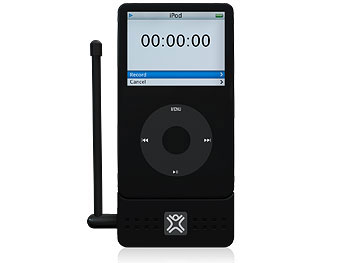
Thanks to the guys at CongressRadio in Germany for pointing out that XtremeMac are working on a piece of software called MicroMemo. I've signed up for more information to see whether they have managed to make any iPod record with 44 kHz quality.

Tuesday, January 10, 2006

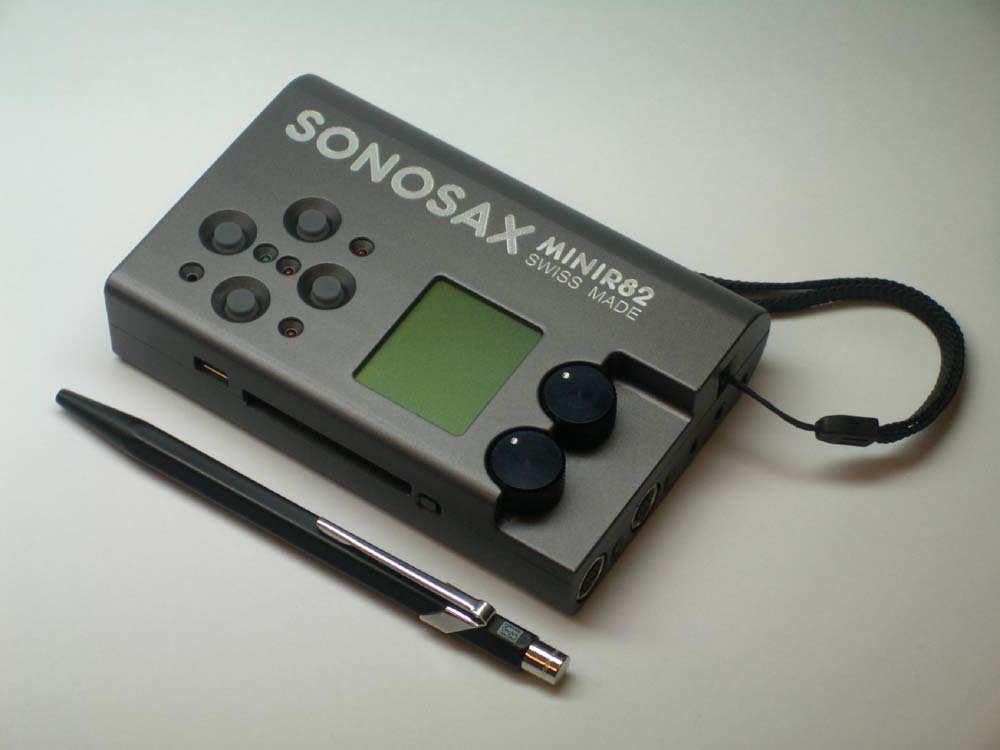
Sonosax MiniR82 - 4500 Euro recorder


Robert Freeman in London sent some nice wishes and says he thought of this blog will perusing this site The Sonosax flash recorder must be hand built since it has a Patek Phillipe price tag. Frankly I'd be scared of losing it.

The site is written in a sort of "Swinglish". In part the sales pitch is..

In our willing to offer sound engineers modern, powerful equipments perfectly tailored to their specific needs, and after almost a year of intensive research and development, taking benefit of the latest innovations of today's available technologies, SONOSAX is proud to introduce the MINIR82 , a robust, small sized hard disk and CompactFlash Card audio recorder specifically designed for on location recording.

Despite its reduced size, only 120 x 80 x 28 mm (4.75” x 3.15” x 1.1”) weighting only 430gr (1/2 pound) with 4xAA standard alkaline batteries, the MINIR82 offers all functionalities and features required in modern mobile sound recording.

Freely configurable from 2 to 8 tracks with recording capabilities from 44,1kHz to 192 kHz at 24bits, writing industry standard WAV and BWF Mono or Stereo audio files to either its internal 20 to 30Gb hard disk or to the CompactFlash card, equipped with two high quality microphone amplifiers with switchable limiters using state of the art SONOSAX technologies, 2 analog line inputs and 8 Digital Inputs ( 4xAES/EBU ), the MINIR82 will be your perfect companion whenever used as a stand alone recorder for ENG/Documentary applications or on a sound cart when used in conjunction with an outboard mixer such as the SONOSAX SX-ST for larger production sets. Of course, the MINIR82 offers full Time Code capability, including HDTV format, and can be used as master or slave.


Do you understand why manufacturers assign the product numbers they do? Not sure I would call a new device the MINIR82. But that applies to most equipment guys. They assume we're all armed with bits of paper as we wander around electronic equipment stores.

Happy New Year 2006

Thanks for all the good wishes - and feedback - in the last couple of weeks. Around half a dozen magazines picked up the news of the survey, so I am going to wait until the middle of February before shutting entries. But it is already clear that the radio industry still have a lot of issues with the current crop of audio recorders out there - from Minidisc to flash. Please keep the feedback coming. There is quite clearly a need to share information in this field.

More on M-Audio Microtrack


M-Audio Microtrack
Originally uploaded by Jonathan Marks.

The Dutch distributor still claims there is no stock, so unable to provide one for review. In the meantime, Tim Locke who works at BBC News shares the following observations. In general, he is positive. But he notes:

1. The unit takes quite a while to boot up - around 20 seconds. A worry for reporters in a hurry..

2. Using the extra gain on the TRS inputs seems to add a "whine" when recording from the BBC's standard Beyer M58s microphones.

3. The inability to swop out batteries is a worry - they have bought an Ipod AA USB battery pack to mitigate against trouble - it would be good to bundle these like the mains ones supplied.

4. The promised mono recording firmware is not out yet, expected Feb 06. - currently they are either having to use hardwired solutions which are clumsy.

5. There's no pause+record function - so you can't tweak your record levels before starting recording.

6. Accidentally hitting the navigation button and inadvertantly pausing during a recording is a too easy.

7. Nav selector for menus can be too sensitive and overshoots intended selection.

8. There is no way to add track marks during recording.

Thursday, December 22, 2005

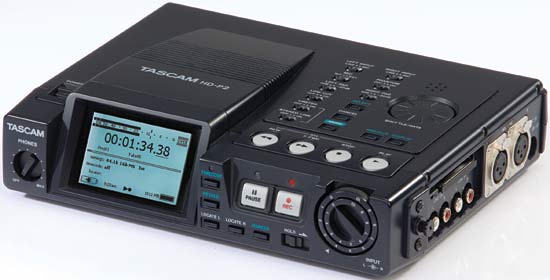
TASCAM HD-P2


TASCAM HD-P2

The HD-P2 from Tascam is now shipping apparently...supposed to be a lot cheaper than Marantz. I like the look of the display.

Wednesday, December 21, 2005

Transom Review M-Audio Microtrack 24/96

Transom Tools: M-Audio Microtrack 24/96: "The M-Audio Microtrack 24/96 "

Despite promises, the M-Audio track is not available in the Netherlands at the moment. It would appear they are feeding customer requirements in the US and UK first. I have given up trying to review this model in 2005. The link above is to one of the best in depth reviews I have seen so far. I am told there IS now a firmware upgrade allowing mono recording without having to make up a special lead.

Monday, December 12, 2005

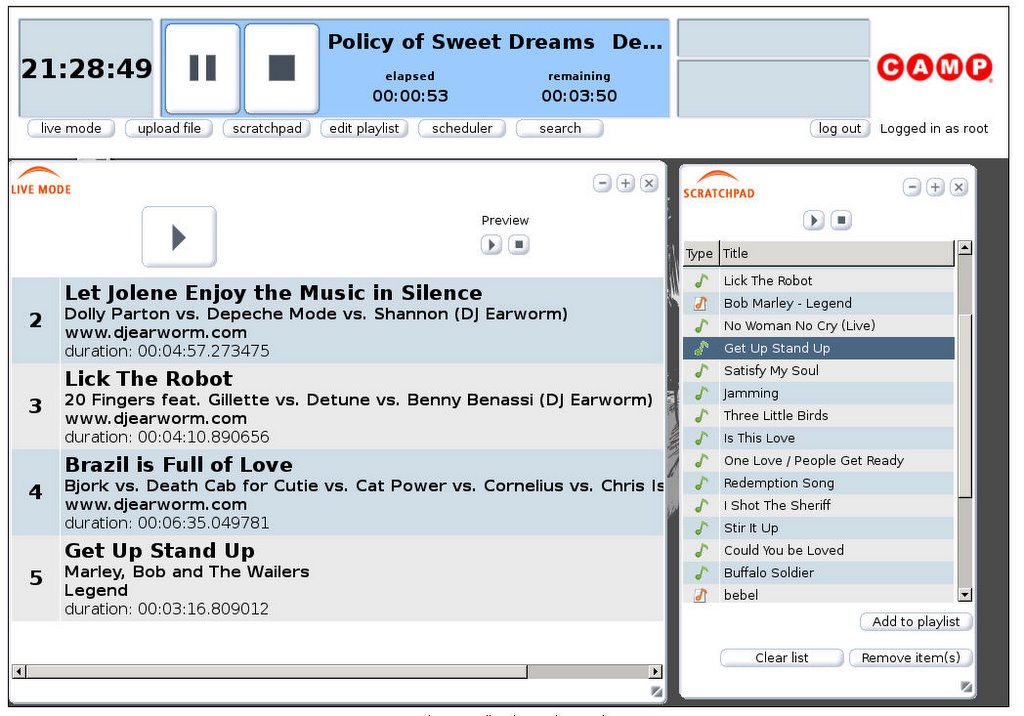
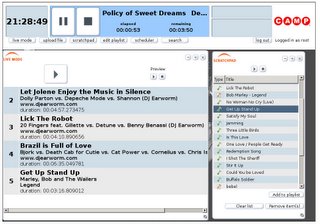
Livesupport Nears Completion of First Stage


Radio is still the most powerful method of disseminating news and educational material to disadvantaged groups and in areas with high poverty, fragile technological infrastructure, and/or instability. But while radio is extremely effective, the tools available to most community stations are very limited in function. The LiveSupport project, based in Prague, seeks to address this by giving stations an open source, end-to-end solution for managing a radio station.


LiveSupport is the first free and open radio management software that provides live studio broadcast capabilities as well as remote automation in one integrated system. They have also understood that such software is worthless unless it is backed by support - and a simple way to maintain it. I've been impressed by the first betas, all of which are posted on the website
As in all Campware products, LiveSupport software is language independent: virtually everything in the user interface can be translated into any language using Unicode. Multilinguality is implemented on all levels of the user interface as well as for the metadata for audio files in the storage system.

LiveSupport has been designed for a Linux environment, but it was built it on top of standard, cross-platform classes. Such an architecture allows for easy porting of LiveSupport to different operating systems in the future.

In short, expect interesting developments in this sector from these guys in the first quarter of 2006.

Saturday, December 10, 2005

Past the 500 Reactions - Thanks


Just to say thanks for the feedback already received on the Podcast recorder survey. I didn't realise people were so passionate about having better recording equipment. It is a real shame that the audio recording quality on the iPod is deliberately crippled (presumably to stop bootlegging at concerts). In the meantime, Numark has released what it calls "iDJ" which is a 2-channel mixer that enables mobile DJs and iPod enthusiasts to seamlessly integrate their portable music libraries with other music systems—transforming the iPod from a personal music player into a source playback device.

ShareThis