You slip your normal SIM card in the slot - and leave this box at home. I guess I'd want to try it out on a trip when it didn't matter too much if my phone wasn't working.
Tuesday, February 20, 2007

SkyQube
Now this is interesting if you do a lot of travel. You connect it up at home and put the SIM card of your mobile into it. When you get to your destination you buy a cheap prepaid SIM that allows you to receive calls for free. This green box uses Skype to beat the roaming charges levied in other countries. Also features a recording function and callback. Cost? About 300 bucks to start with. Might be worth experimenting with for reporters in "difficult" countries? More details at www.Qoolabs.com. Seen at the 3GSM conference in Barcelona last week.


Saturday, February 10, 2007
DRM85CSHEETV31.pdf (application/pdf Object)
DRM85CSHEETV31.pdf (application/pdf Object)
I see that HHB in the UK is now selling a cardiod version of the integrated Flashmic 1GB flash recorder. The older one uses an omnidirectional mike. This one is better for noisy surroundings, but less handy for doing general interviews because you have to make sure it is pointing accurately or you'll hear nothing off mike. I wonder why they can't put 2GB in the device now for the same price. 1 GB is super cheap these days.
I see that HHB in the UK is now selling a cardiod version of the integrated Flashmic 1GB flash recorder. The older one uses an omnidirectional mike. This one is better for noisy surroundings, but less handy for doing general interviews because you have to make sure it is pointing accurately or you'll hear nothing off mike. I wonder why they can't put 2GB in the device now for the same price. 1 GB is super cheap these days.
Monday, February 05, 2007
Power Alternatives

So you're out in the middle of nowhere in a jeep (or on a plane). What about charging your recorder, laptop, camera, moviecamera, torch, etc. You could take spare batteries for everything, or get one of these inverters for around 100 dollars. It also has USB power outlets to charge iPods, Blackberries, some phones. Haven't seen 220 volt models. Doesn't matter for most travel devices these days - 110 volts is fine.
Sunday, February 04, 2007
EJamming nears Launch

Interesting to see how musicians are collaborating on line. Just a few weeks ago, noticed a demo of eJamming. The blurb on the site reads....
Say you’re putting a band together and you can’t find a killer bass player in your town. Or you’re sitting there sequencing a great piece of music but your drumming sucks and you’re no Eddie Van Halen on guitar. Or your old band mates now live in Seattle, New York and Nashville and you’d kill to play together again. What’s the answer?
Just plug any digital instrument that’s enabled for GENERAL MIDI – a MIDI-enabled keyboard, a MIDI-enabled guitar or MIDI-enabled bass, MIDI-enabled drums, or a MIDI-enabled wind-controller -- into your PC or Mac computer, fire up the eJamming® Studio and we’re connecting you over the Internet to a whole world of musicians across town – or across the ocean.
In Sync. In Real Time. Or in as close to real time as the laws of physics allow.
And now that eJamming Studio comes with our own exclusive Sonic Implants Sound Set inside – it’s even easier to create and collaborate together over the Internet!
Friday, February 02, 2007
MicroHDTV Camera

A novel miniature camera allows viewers to enjoy a new live experience and watch a ski jump or a car race in high resolution from the actor’s perspective. The camera is so tiny that it even fits inside the cramped cockpit of a racing car. Until recently, this could only be done in standard TV resolution. Now these images have made the leap to ‘high-definition TV’ (HDTV), thanks to a mini-camera developed by researchers at the Fraunhofer Institute for Integrated Circuits IIS in Erlangen. Several licensees will soon be putting the camera into series production.
Measuring 4 by 4 by 8 centimeters, the camera is smaller than a bar of soap and can even be accommodated in a cramped racing-car cockpit or a ski jumper’s helmet. »The MicroHDTV model is one of the smallest HDTV cameras currently available,« says Stephan Gick, group leader at the IIS. »We achieved this chiefly by taking two different approaches: The camera’s electronics have a very low power loss, which means that little heat is generated and the housing can thus be kept very small. By using highly integrated parts, we were able to fit all of the components such as the image sensor, the analog-to-digital converter, the color processor and several interfaces into the tiny space available inside the camera.«
With its format of 1920 x 1080 pixels and a variable frame rate of up to 60 frames per second, the camera meets all the requirements expected of a professional HDTV production. All parameters – such as color settings, white balance, image format and frame rate – can be controlled using the integrated software. All it takes is to open a web browser, connect the camera to the notebook via a local network and set the desired parameters. »Because the camera is so small and can be controlled via the Internet, it can deliver pictures of scenes that could not be viewed in the same way before – for example, recordings of sports events or applications that require the camera to be installed in difficult-to-reach places,« says Gick.
Another of the camera’s advantages is that it can be operated using standard optical systems. The MicroHDTV camera will be on display at the CeBIT trade fair (Hall 9, Stand B36), which will take place in Hanover, Germany from March 15 to 21 2007.
More information from Dipl.-Ing. Stephan Gick, Phone: +49 9131 776-521
Fax: +49 9131 776-598
Fraunhofer-Institut für Integrierte Schaltungen IIS
Am Wolfsmantel 33
91058 Erlangen, Germany
Thursday, January 18, 2007
Brilliant Resource to P2P
Michel Bauwens of the P2P foundation pointed me in the direction of their wiki which is turning into a truly excellent guide to editing and distribution software.
http://www.p2pfoundation.net/Category:Audiovisual
is the place to check out. Very well done - and clever to use the wiki concept.
http://www.p2pfoundation.net/Category:Audiovisual
is the place to check out. Very well done - and clever to use the wiki concept.
Monday, January 15, 2007
GigaVox Media, Inc. » The Levelator™
GigaVox Media, Inc. » The Levelator™
If you are doing podcasts, then check out this excellent piece of free software to balance the overall levels before you post. There are versions for both Mac and Windows.
Here's what the author's say:
We've released the all-new non-beta version of The Levelator for Windows and OS X. A Linux version is coming soon. This is a major upgrade from the earlier beta-test release. Special thanks to our
team: Bruce Sharpe, Norm Lorrain, Tim McNerney and to the users and beta testers who sent in sample audio files and bug reports.
Here's what's new:
* A cool new interface.
* Significant improvements in the levelation algorithms. (Thanks
to all those who submitted challenging audio files. We used every one of them in our testing.)
o improved handling of background noise
o improved processing of stereo files
o fewer "breathing" and "pumping" artifacts
* All sample rates and bit depths are now supported. Previously,
some such as 22,050Hz and 24-bit were not.
* Renaming the application files to simply "Levelator" in order
to make the application easier to locate in alpahbetized
lists.
* Elimination of the Java Web Start user interface in favor of a
native UI for each platform.
* Easing of restrictions on commercial use. (Read the new
license.)
* You can now drag-and-drop an audio file onto the applications
icon, even if the application is not currently running.
* The application window can now be minimized.
* OS X 10.3 (Panther) is now supported.
* You can drag-and-drop an audio file onto the application's icon
in the Dock (OS X).
* Temporary files are managed more efficiently.
* T-Shirts and web-site buttons!
Download The Levelator (v1.1):
http://ipost.com/rd/9z1zb00ja4se1isdbcs5f996ejtvit0jbba0ic38q70
The New License:
http://ipost.com/rd/9z1z4dk0tisan2ks4v6l72bankn8c1vito7n0c805ko
T-Shirts and Web-Site Buttons!
http://ipost.com/rd/9z1z7ekj0c428vgi0rqq1838tvjr7plajo738sn2ddo
_______________________________________________________________
An Important New Survey
_______________________________________________________________
If you love The Levelator -- okay, even if you don't -- please
spend just one minute completing our new survey. We're working
on the next release of cool new products for podcasters, and
your input can have a significant impact on what we do and how
we do it. Trust me, we really do take your input very seriously.
Our One-Minute Survey:
http://ipost.com/rd/9z1zk5nrghitcn9o02ci8o6io0qrak4banhrsuatft0
If you are doing podcasts, then check out this excellent piece of free software to balance the overall levels before you post. There are versions for both Mac and Windows.
Here's what the author's say:
We've released the all-new non-beta version of The Levelator for Windows and OS X. A Linux version is coming soon. This is a major upgrade from the earlier beta-test release. Special thanks to our
team: Bruce Sharpe, Norm Lorrain, Tim McNerney and to the users and beta testers who sent in sample audio files and bug reports.
Here's what's new:
* A cool new interface.
* Significant improvements in the levelation algorithms. (Thanks
to all those who submitted challenging audio files. We used every one of them in our testing.)
o improved handling of background noise
o improved processing of stereo files
o fewer "breathing" and "pumping" artifacts
* All sample rates and bit depths are now supported. Previously,
some such as 22,050Hz and 24-bit were not.
* Renaming the application files to simply "Levelator" in order
to make the application easier to locate in alpahbetized
lists.
* Elimination of the Java Web Start user interface in favor of a
native UI for each platform.
* Easing of restrictions on commercial use. (Read the new
license.)
* You can now drag-and-drop an audio file onto the applications
icon, even if the application is not currently running.
* The application window can now be minimized.
* OS X 10.3 (Panther) is now supported.
* You can drag-and-drop an audio file onto the application's icon
in the Dock (OS X).
* Temporary files are managed more efficiently.
* T-Shirts and web-site buttons!
Download The Levelator (v1.1):
http://ipost.com/rd/9z1zb00ja4se1isdbcs5f996ejtvit0jbba0ic38q70
The New License:
http://ipost.com/rd/9z1z4dk0tisan2ks4v6l72bankn8c1vito7n0c805ko
T-Shirts and Web-Site Buttons!
http://ipost.com/rd/9z1z7ekj0c428vgi0rqq1838tvjr7plajo738sn2ddo
_______________________________________________________________
An Important New Survey
_______________________________________________________________
If you love The Levelator -- okay, even if you don't -- please
spend just one minute completing our new survey. We're working
on the next release of cool new products for podcasters, and
your input can have a significant impact on what we do and how
we do it. Trust me, we really do take your input very seriously.
Our One-Minute Survey:
http://ipost.com/rd/9z1zk5nrghitcn9o02ci8o6io0qrak4banhrsuatft0
HairerSoft - Amadeus Pro
HairerSoft - Amadeus Pro
Has anyone had any experience with this Mac (only) sound editing software? I haven't seen it at any stations, but it may be a cheaper alternative to other packages for home/small business use.
Amadeus Pro is a powerful multitrack audio editor supporting a variety of formats including MP3, AAC, Ogg Vorbis, Apple Lossless, AIFF, Wave and many others. Click on one of the thumbnails below to see a larger version of it.
Multitrack editor Amadeus Pro is a fully featured multitrack editor. Each track can have its volume adjusted independently from the others. Amadeus Pro fully supports multitrack WAVE files and allows you to render sound on up to 5 different loudspeakers simultaneously.
Batch processing There's that whole collection of files that you wanted to convert to Mp3, but you first wanted to normalize them and make them fade in and out nicely. Several hours of work in perspective? Let Amadeus Pro do the work for you! The powerful batch processor allows you not only to convert large numbers of files between any of the supported formats, but you can also instruct Amadeus Pro to apply any sequence of sound effects.
Repair centre The handy repair centre allows you to find and to repair cracks with a simple click of the mouse. Furthermore, Amadeus Pro's powerful denoising functions allow you to easily get rid of that annoying hiss on your old tape recordings or of that 50Hz hum picked
Has anyone had any experience with this Mac (only) sound editing software? I haven't seen it at any stations, but it may be a cheaper alternative to other packages for home/small business use.
Amadeus Pro is a powerful multitrack audio editor supporting a variety of formats including MP3, AAC, Ogg Vorbis, Apple Lossless, AIFF, Wave and many others. Click on one of the thumbnails below to see a larger version of it.
Multitrack editor Amadeus Pro is a fully featured multitrack editor. Each track can have its volume adjusted independently from the others. Amadeus Pro fully supports multitrack WAVE files and allows you to render sound on up to 5 different loudspeakers simultaneously.
Batch processing There's that whole collection of files that you wanted to convert to Mp3, but you first wanted to normalize them and make them fade in and out nicely. Several hours of work in perspective? Let Amadeus Pro do the work for you! The powerful batch processor allows you not only to convert large numbers of files between any of the supported formats, but you can also instruct Amadeus Pro to apply any sequence of sound effects.
Repair centre The handy repair centre allows you to find and to repair cracks with a simple click of the mouse. Furthermore, Amadeus Pro's powerful denoising functions allow you to easily get rid of that annoying hiss on your old tape recordings or of that 50Hz hum picked
Monday, January 01, 2007
Happy New Year 2007

Clock Radio, Media Gallery
Originally uploaded by Jonathan Marks.
Hello, thanks for dropping by and may all the dreams and promises for new equipment come true in 2007. And a safe and healthy one too for all of us. See you further down the blog.
Saturday, December 09, 2006
Bose iPod In Ear Heaphones
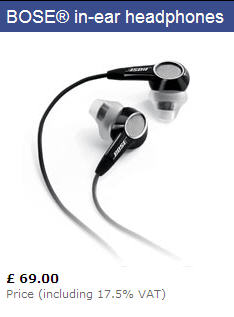
I have trialled a pair of these headphones. They are truly the best of their breed, although they are also the most expensive. 69 quid on Regent Street. But the audio quality is simply amazing. Ideal for clandestine recordings in the field. They come with three sizes of earpieces to ensure a snug fit. But I am surprised that they didn't include two sets. The case for the headphones is clever too....neatly protects the headphones, though it closes with a magnetic clip which needs to be kept away from credit cards.
Linux software for radio stations launches

I am currently looking at this piece of software as one possibile solution for a radio station in West Africa. One challenge with the Open-Source project like this is that the developers cannot offer a 24 hour service, like other guys do for Linux. But I have met the people behind this project and know them to be passionate about getting it right.
Community radio stations in Sierra Leone and in other emerging democracies will be powered by the latest release of the free and open source Campcaster software, which was released on December 7th 2006. Campcaster is free and open source software that turns a PC running the free Linux operating system into an essential tool for radio broadcasting. In a user-friendly way, it enables both automated broadcast at preset dates and times, as well as allowing “live” playout from the studio. At the same time, it also enables the exchange of radio program material both online and off-line, and provides a stable, secure, extensible archive server for storing, searching and retrieving program content.
Campcaster 1.1, code-named “Freetown,” was built with conditions in difficult environments such as Sierra Leone in mind. It provides very stable playout, and because it runs on Linux, there are fewer problems with viruses, spyware and malware.
Campcaster's relevance is not limited to the developing world: stations in the developed world are starting to adapt the system to their own needs. For example, Vienna, Austria's Radio Orange is adapting Campcaster's playout system to work with its existing digital archive, while in Hungary, a network of independent radio stations is integrating Campcaster's storage server into its IKRA project, a generic public website engine for radio stations.
Because all of the Campcaster software is free and open source, stations are free to adapt it to their individual needs, but are strongly encouraged to share their efforts with others.
“Campcaster provides features that used to be only available in extremely expensive commercial radio systems,” says Sava Tatić, Managing Director of the Media Development Loan Fund's Center for Advanced Media, Prague (CAMP), which coordinates the Campware Initiative. “We believe there is a strong north-south aspect to using and extending Campcaster,” Tatić added. “Every time a station in North America or Europe adapts and extends Campcaster, stations in places like Sierra Leone benefit.”
An international team of software developers, user interface designers, media activists and radio professionals have worked for more than 12 months on the 1.1 “Freetown” release. Campware representatives have coordinated their work with the Cornet community radio network on the software, and members of the development team will travel to Freetown, Sierra Leone later this month to provide training to partners implementing and servicing Campcaster locally.
Campcaster 1.1 “Freetown” is the latest release from the Media Development Loan Fund's Campware Initiative, which creates free and open source tools for independent media in emerging democracies. Initial funding for Campcaster has been provided by a grant from the Open Society Institute. The tools are all free and available for download at the Campware website at www.campware.org. Developers and technically-minded users can visit the developers' page at http://code.campware.org/projects/campcaster.
Douglas Arellanes Head of Research and Development on the project tells me that he and programmer Ferenc Gerlits are now in Freetown, Sierra Leone to install Campcaster at the Cornet network of community radio stations. They already have confirmation that a number of other stations have already begun installing and extending Campcaster, and they will regularly update the Campware site as we hear about new implementations.
Next on their release program (in addition to bugfix releases) is Campcaster 1.2, which is code-named "Kotor" because they are planning to implement it at Skala Radio in Kotor, Montenegro. The main feature will be integration with Campsite, which will allow stations to create and manage news broadcasts in an effective and user-friendly manner.
Thursday, December 07, 2006
Technica Del Arte Recorder
 Been busy comparing this device (which is a software package) from Maastricht based Technica del Arte with other handheld recorders. I'm impressed that this device will record in MPEG-1 Layer 2 (as used in systems like Dalet) and send the recording to the station (or web server) at the touch of one button.
Wednesday, December 06, 2006
Zoom H4

This recorder comes from the manufacturer of Zoom in Tokyo Japan. Don't bother trying to correspond with them, they simply refer you to dealers. In the Europe, that has proved to be disappointing, although detailed photos and the complete manual are up on the Samson site, who distribute Zoom products in the USA.
It is on sale in the US for US$299, which makes it cheaper than some microphones out there. In the US, a wall outlet power supply, camera stand mount, 128MB SD card are standard issue with the unit. That flash memory card will only give you about 12 minutes of recording time using the .wav file format. A 2 GB SD card should give about 200 minutes (3 hrs, 20 min) of std .wav record time although there is no mention of write speed for the SD memory is given.
Phantom Power is available at either 24V or 48V for external micrphones that need it. No hum or noise was noticed when using the phantom supply for the external microphones. Mic levels can be set via slide switches on the side of the H4 and finely adjusted in the input menu options.
The device also has a 4-track mode, but that has not yet been explored. Quality of the internal microphones is fine for interview work. The case is plastic (what do you expect for 299?) and the menu's take some getting used to. A better job than the M-audio, not as robust as the HHB Flash Microphone (but then it is 1/3rd of the price).
Sunday, December 03, 2006
B & G Building on opening night

B & G Building on opening night
Originally uploaded by Jonathan Marks.
The centre is certainly going to be a great place, not only for the Media experience, but for conferences. I am curious to see how the collections will grow. At the moment they have done a fantastic job of explaining the past and bring this into a contemporary context. The challenge will be to project into the future - showing how mobile technology will be part of the tool set for content producers of the future.
Apart from the challenges with the sound, I can thoroughly recommend a visit. Many of the interviews I made for Radio Nederland Wereldomroep on the future of media are shown in the exhibit "The Global Village". They turned out nicely.
Subscribe to:
Posts (Atom)