Saturday, December 09, 2006

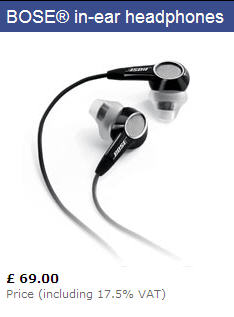
Bose iPod In Ear Heaphones


I have trialled a pair of these headphones. They are truly the best of their breed, although they are also the most expensive. 69 quid on Regent Street. But the audio quality is simply amazing. Ideal for clandestine recordings in the field. They come with three sizes of earpieces to ensure a snug fit. But I am surprised that they didn't include two sets. The case for the headphones is clever too....neatly protects the headphones, though it closes with a magnetic clip which needs to be kept away from credit cards.

Linux software for radio stations launches


I am currently looking at this piece of software as one possibile solution for a radio station in West Africa. One challenge with the Open-Source project like this is that the developers cannot offer a 24 hour service, like other guys do for Linux. But I have met the people behind this project and know them to be passionate about getting it right.

Community radio stations in Sierra Leone and in other emerging democracies will be powered by the latest release of the free and open source Campcaster software, which was released on December 7th 2006. Campcaster is free and open source software that turns a PC running the free Linux operating system into an essential tool for radio broadcasting. In a user-friendly way, it enables both automated broadcast at preset dates and times, as well as allowing “live” playout from the studio. At the same time, it also enables the exchange of radio program material both online and off-line, and provides a stable, secure, extensible archive server for storing, searching and retrieving program content.

Campcaster 1.1, code-named “Freetown,” was built with conditions in difficult environments such as Sierra Leone in mind. It provides very stable playout, and because it runs on Linux, there are fewer problems with viruses, spyware and malware.

Campcaster's relevance is not limited to the developing world: stations in the developed world are starting to adapt the system to their own needs. For example, Vienna, Austria's Radio Orange is adapting Campcaster's playout system to work with its existing digital archive, while in Hungary, a network of independent radio stations is integrating Campcaster's storage server into its IKRA project, a generic public website engine for radio stations.

Because all of the Campcaster software is free and open source, stations are free to adapt it to their individual needs, but are strongly encouraged to share their efforts with others.

“Campcaster provides features that used to be only available in extremely expensive commercial radio systems,” says Sava Tatić, Managing Director of the Media Development Loan Fund's Center for Advanced Media, Prague (CAMP), which coordinates the Campware Initiative. “We believe there is a strong north-south aspect to using and extending Campcaster,” Tatić added. “Every time a station in North America or Europe adapts and extends Campcaster, stations in places like Sierra Leone benefit.”

An international team of software developers, user interface designers, media activists and radio professionals have worked for more than 12 months on the 1.1 “Freetown” release. Campware representatives have coordinated their work with the Cornet community radio network on the software, and members of the development team will travel to Freetown, Sierra Leone later this month to provide training to partners implementing and servicing Campcaster locally.

Campcaster 1.1 “Freetown” is the latest release from the Media Development Loan Fund's Campware Initiative, which creates free and open source tools for independent media in emerging democracies. Initial funding for Campcaster has been provided by a grant from the Open Society Institute. The tools are all free and available for download at the Campware website at www.campware.org. Developers and technically-minded users can visit the developers' page at http://code.campware.org/projects/campcaster.


Douglas Arellanes Head of Research and Development on the project tells me that he and programmer Ferenc Gerlits are now in Freetown, Sierra Leone to install Campcaster at the Cornet network of community radio stations. They already have confirmation that a number of other stations have already begun installing and extending Campcaster, and they will regularly update the Campware site as we hear about new implementations.

Next on their release program (in addition to bugfix releases) is Campcaster 1.2, which is code-named "Kotor" because they are planning to implement it at Skala Radio in Kotor, Montenegro. The main feature will be integration with Campsite, which will allow stations to create and manage news broadcasts in an effective and user-friendly manner.

Thursday, December 07, 2006

Technica Del Arte Recorder

  Been busy comparing this device (which is a software package) from Maastricht based Technica del Arte with other handheld recorders. I'm impressed that this device will record in MPEG-1 Layer 2 (as used in systems like Dalet) and send the recording to the station (or web server) at the touch of one button. Posted by Picasa

Wednesday, December 06, 2006

Zoom H4


This recorder comes from the manufacturer of Zoom in Tokyo Japan. Don't bother trying to correspond with them, they simply refer you to dealers. In the Europe, that has proved to be disappointing, although detailed photos and the complete manual are up on the Samson site, who distribute Zoom products in the USA.

It is on sale in the US for US$299, which makes it cheaper than some microphones out there. In the US, a wall outlet power supply, camera stand mount, 128MB SD card are standard issue with the unit. That flash memory card will only give you about 12 minutes of recording time using the .wav file format. A 2 GB SD card should give about 200 minutes (3 hrs, 20 min) of std .wav record time although there is no mention of write speed for the SD memory is given.

Phantom Power is available at either 24V or 48V for external micrphones that need it. No hum or noise was noticed when using the phantom supply for the external microphones. Mic levels can be set via slide switches on the side of the H4 and finely adjusted in the input menu options.

The device also has a 4-track mode, but that has not yet been explored. Quality of the internal microphones is fine for interview work. The case is plastic (what do you expect for 299?) and the menu's take some getting used to. A better job than the M-audio, not as robust as the HHB Flash Microphone (but then it is 1/3rd of the price).

Sunday, December 03, 2006

B & G Building on opening night


B & G Building on opening night
Originally uploaded by Jonathan Marks.

The centre is certainly going to be a great place, not only for the Media experience, but for conferences. I am curious to see how the collections will grow. At the moment they have done a fantastic job of explaining the past and bring this into a contemporary context. The challenge will be to project into the future - showing how mobile technology will be part of the tool set for content producers of the future.

Apart from the challenges with the sound, I can thoroughly recommend a visit. Many of the interviews I made for Radio Nederland Wereldomroep on the future of media are shown in the exhibit "The Global Village". They turned out nicely.

Looking down from the atrium


Looking down from the atrium
Originally uploaded by Jonathan Marks.

The design of the archive part of the building is inspiring....more like working in the Colosseum in Rome than a broadcast archive.

Looking up from Atrium


Looking up from Atrium
Originally uploaded by Jonathan Marks.

The ceiling is like being in the cupboard under the stairs, in a very big cupboard. Inspiring when you see it in real life. The building is an acoustic engineer's nightmare though. The reflections from the walls mean that the sound in the Media Experience, especially accompanying what they describe as the world's biggest screen, is the only main disappointment.

Your Personal Guide


Your personal guide
Originally uploaded by Jonathan Marks.

When you go into the media experience, you can choose one of the Netherlands news presenters to act as a guide. Three women and one man. Interesting that they each have a different text...not the same. They come from both public and commercial broadcasting. It is nicely done.

Early Podcast equipment


Early Podcast equipment
Originally uploaded by Jonathan Marks.

A relatively small part of the exhibition in Hilversum is a static display of equipment, like this domestic tape recorder from 1961. It reminds me of the Mission Impossible TV show. Those reel sizes were great for 10 minute messages at 3 3/4 ips speed. The rest are interactive exhibits.

Looking down on the Global Village


Looking down on the Global Village
Originally uploaded by Jonathan Marks.

The world is one "media experience" richer. On December 1st, Queen Beatrix officially opened a new permanent exhibition which tells the story of Dutch broadcasting in a global context. Three floors of the new Netherlands Instiute for Sound and Vision have been dedicated to a public display of what both the commercial and public radio & TV stations mean to Dutch society. It is not a museum - it is indeed an experience.

Friday, November 10, 2006

Radio Roundabout...the town of two towers


I know this is off-topic, but I hope you'll fogive me.


So there I am, driving along the Randweg, a road on the southern side of the my home town, Huizen, in the Netherlands.

I came up to a roundabout that has been recently renovated and what did I see? A fifth-size replica of the world's first rotatable shortwave transmitting tower....slap bang in the middle of a new roundabout. Went back home to get the camera...just couldn't believe it. It was made of wood and stood on a site about 300 metres from the roundabout between 1937 until 22nd September 1958 when it was blown-up. Seems it took four attempts to knock the 63 metre high masts over. A new, more powerful site in Lopik, near Utrecht took over the transmissions of what was, by then, Radio Nederland Wereldomroep. The scale-model is just over 12 metres high.

As I was filming this new monument, I got mixed reactions from passers by. Some seem to be dead against it, probably because they hadn't a clue what it was. Some older folk, born and bred in this fishing village, were kinda proud of Huizen's link with the past. One kindly old gent offered to show me a set of old photos he'd kept. Another lady remember playing in the masts in 1958 when the towers were awaiting demolition. She also recalled how the turntable used to make a strange squeal like wheels on a railway engine as it spun round late in the afternoons and at night. The antenna strung between the masts was directional. By rotating it, the signal could be beamed in different directions, mainly to Asia, Africa and North America. The antenna, I believe, was actually tuned to a single frequency in the early days, 9590 kHz in the 31 metre band.
More pictures on my Flickr pages.  Posted by Picasa

Wednesday, November 01, 2006

Tape Recorder Collection


Tape Recorder Collection
Originally uploaded by Jonathan Marks.

Just taken a tour of a fascinating museum located in the gardens behind St Peter's Basilica. Its a collection of equipment used by reporters and broadcasters at Vatican Radio and also houses some standby medium and shortwave transmitters. Nice to see the old UHER sitting there. My first machine.

Wednesday, October 18, 2006

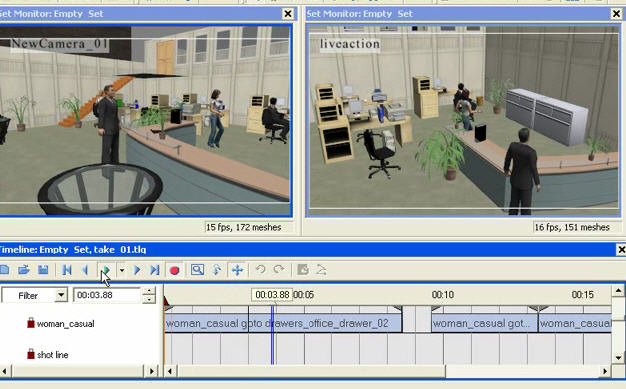
SIMS for TV creatives

Imagine the SIMS program, but then adapted in a way to use the character animations to preplan and produce TV drama or documentaries. No broadcaster will pay for rehearsal time any more, so you must arrive at a scene with a storyboard and a camera shot list already in your mind before the camera's role. I first saw Antics version 2 at IBC 2005. After a period of silence, the fruit of their work is now on sale for under 1000 Euros and, judging from the paces I have been putting it through, it is quite simply brilliant. Download a trial copy and try it for yourself. You need to devote some concentrate time to learning how to play with it, but it is a gentle learning curve. The great thing is being able to save the final scenes that you've planned as a DVD, so you can show the client just what you have in mind before any production starts. Better by miles than any paper storyboard and a great way to practice the shots. I particularly like the fact you can record dialogue and have the animation speak it for you. I am sure some people will use this program to make shows in their own right. In short, good news for the creative world - obviously a huge amount of love and care went into this. By the way, I have no commercial connection with these guys. I just believe good news should be celebrated.

Monday, October 16, 2006

More Background to what I am doing

This post is to tell you that the people behind this blog have come up with a new -free- Critical Distance Newsletter , the October 2006 Edition 9. It deals with news about this blog, but other broadcast related material as well. You can subscribe, if you like, by signing up at the Critical Distance switchboard. Unsubscribing is also easy, so don't feel locked in. Likewise, we do not use the mailing list for anything else than sending the newsletter. No phones will ring, no salesmen will call. It is in PDF format.

Tuesday, October 10, 2006

Podcasters Microphone


UK distributor Source Distribution has announced the availability of the new Røde Podcaster – which claims to be the world’s first broadcast quality USB microphone.

Based on Røde’s acclaimed Broadcaster microphone, like the NT2, the Podcaster delivers "studio-grade results through a tight cardioid response that seamlessly connects directly to PC or Mac with a single USB cable, avoiding the added cost and complexity of a separate computer audio interface".

Ideal for online broadcasters, the mic also provides a convenient solution for anyone who records audio directly to their computer, including journalists, voice-over artists, musicians, students and multi-media professionals.

The Podcaster is powered entirely from the USB bus, and uses high-grade A-D converters for optimum quality. It comes complete with an onboard high-output headphone amp for direct monitoring purposes, along with a dedicated volume control and a 3.5mm minijack headphone output. A green status LED indicates that the mic is active and ready for recording.

The microphone comes complete with a microphone stand mount and 5 metres of USB cable. Optional accessories available shortly include a suspension mount and an anglepoise table mounting arm.

To further enhance the Podcaster’s features, Røde has also developed optional downloadable software that allows the user to control the Podcaster’s recording level, to monitor levels via an LED level meter, and to mute the microphone when playing back recordings. This software is available from www.rodepodcaster.com - a dedicated site that also provides podcast hosting as well as offering a wealth of podcasting information and tips.

Oh, and the price? UK 149 pounds including UK VAT.
ShareThis